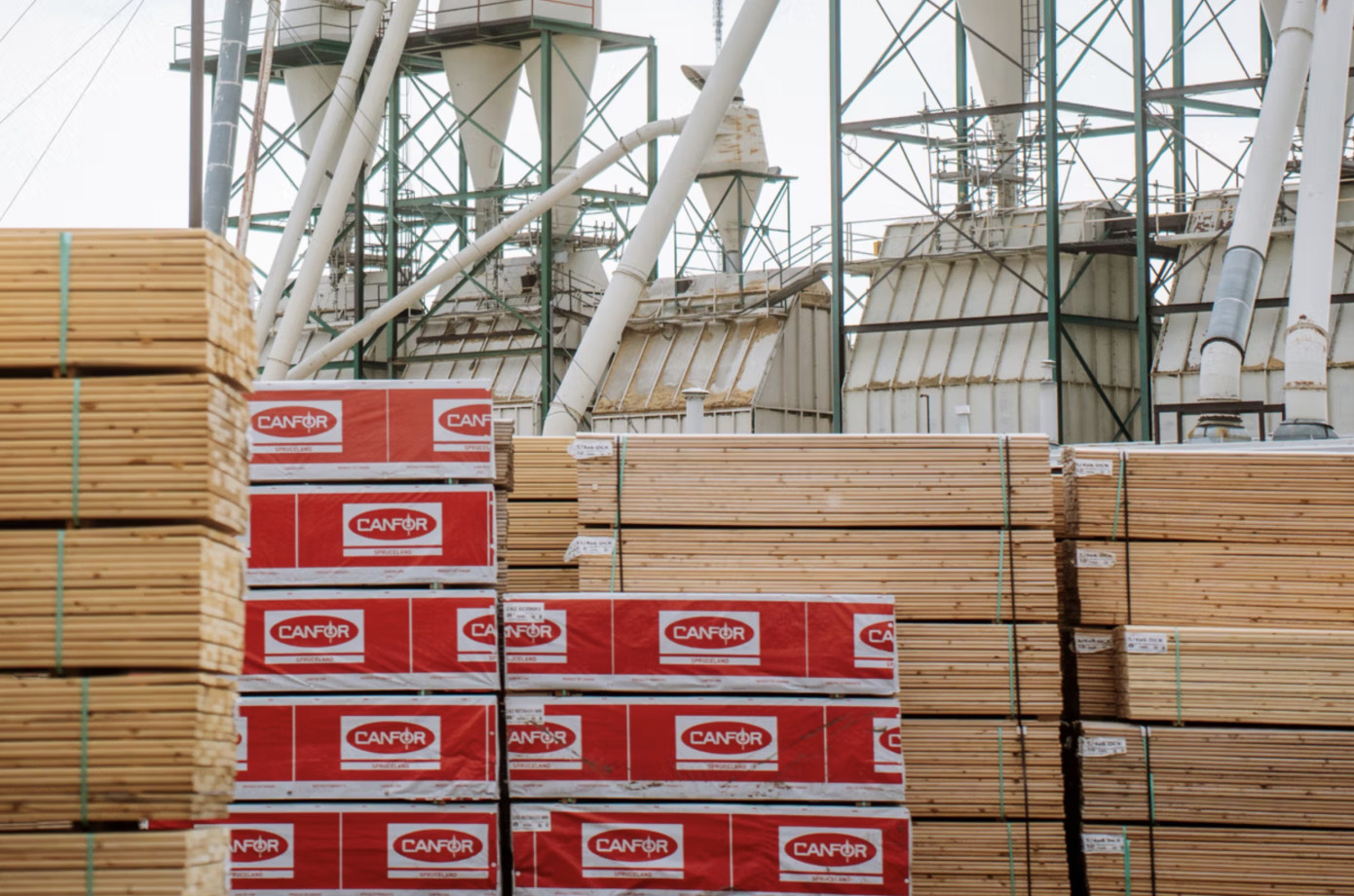
Canfor reports an operating loss of $72.5 million and a shareholder net loss of $72.1 million in the first quarter of 2026, as demand stays subdued and trade and geopolitical pressures weigh on lumber and pulp markets, while periods of supply tightness lift benchmark lumber prices.
In lumber, the company reports a $43.7 million operating loss, narrower than the prior quarter, as North American benchmark prices rise after seasonal downtime in Western Canada and weather disruptions in the U.S. South reduce supply late in 2025 and into 2026. The quarter includes lower shipments across regions, with Europe most affected by early-2026 weather disruptions, and a 2% stronger Canadian dollar versus the U.S. dollar.
The company describes North American lumber demand as weak late in the quarter, with elevated U.S. countervailing and anti-dumping duties and tariffs continuing to weigh on buying. It also links reduced purchasing activity to geopolitical uncertainty tied to the conflict in Iran, alongside cost inflation that affects trade flows and purchasing behavior.
Operationally, total lumber shipments fall 6% from the prior quarter to 1.26 billion board feet, driven by a 9% decline in Europe from cold-weather production impacts and a 4% decline in North America tied to rail supply constraints in British Columbia and weather disruptions in the U.S. South. Total lumber production rises 2% to 1.21 billion board feet as North American operating hours increase after seasonal holiday downtime in the prior quarter.
Benchmark lumber prices rise during the quarter, with Western SPF 2x4 #2&Btr averaging $463 per thousand board feet, up 10% from the prior quarter, and SYP East 2x4 #2 averaging $495 per thousand board feet, up 35%. The company reports that Western SPF unit sales realizations are broadly flat quarter over quarter as offshore realizations and the stronger Canadian dollar offset the benchmark price increase.
In Asia, the release describes conditions as challenging, with China’s weak housing demand and a seasonal slowdown in manufacturing activity pressuring prices. It reports softer demand and pricing in Japan due to higher import volumes from Canada and Europe and a shift toward domestic wood use.
In Europe, the company reports weak demand and slightly lower pricing quarter over quarter, with spruce showing late-quarter improvement after industry curtailments, while elevated pine inventories weigh on pricing, especially in the UK. It also links higher freight costs and weaker purchasing to the conflict in Iran, and notes colder-than-normal early-2026 weather as another demand constraint.
In pulp and paper, Canfor reports a $16.2 million operating loss, improved from the prior quarter, driven by a modest uplift in U.S.-dollar softwood pulp pricing tied to global supply disruptions and a 30% increase in pulp shipments. Average NBSK list prices to China average $685 per tonne, up 2% from the prior quarter, while producer inventories end February at 47 days of supply, at the top end of the stated balanced range.
The company schedules a maintenance outage at its Intercontinental NBSK pulp mill in the second quarter of 2026 that it expects to reduce NBSK market pulp production by about 20 thousand tonnes, and it also plans an outage at its paper machine that it expects to reduce paper production by 5 thousand tonnes. It forecasts global softwood kraft pulp market conditions will remain challenging in the second quarter, with inventories expected to stay elevated and pricing expected to remain subdued.
For lumber, the company forecasts North American markets will soften later in the second quarter of 2026 as supply increases in response to recent price improvements, while demand remains constrained by macroeconomic uncertainty and heightened geopolitical risk. It also projects continued global trade flow disruptions tied to the conflict in Iran, with supply chain constraints, particularly for petroleum-based products, expected to affect new housing construction and add pricing volatility.
At March 31, 2026, on a consolidated basis including Vida, Canfor reports $60.2 million of cash and cash equivalents, $440.8 million drawn on operating loans and facilities, $53.0 million reserved for standby letters of credit, and available and undrawn operating loan facilities of $906.5 million.