
Canada and China have signed a memorandum of understanding to enhance cooperation on modern wood construction as part of their new strategic and economic partnership, according to the Office of the Prime Minister of Canada.
The memorandum involves the Department of Natural Resources of Canada, the Ministry of Forests of the Province of British Columbia, and the Ministry of Housing and Urban-Rural Development of the People’s Republic of China. The agreement will strengthen technical exchanges and cooperation in modern wood construction.
The memorandum is part of the Canada–China Economic and Trade Cooperation Roadmap announced during Prime Minister Mark Carney’s official visit to Beijing in January 2026. The roadmap sets commitments to advance sustainable and low-carbon trade, including cooperation in forestry and wood construction.
Canada ranked as the third-largest supplier of softwood lumber to China in January–November 2025, exporting a total of 942.7 thousand m3 over the eleven-month period, according to Lesprom Analytics. Russia remained the dominant supplier with 9,450.3 thousand m3, accounting for nearly 70% of China’s total softwood lumber imports, while Belarus followed with 992.0 thousand m3. Canadian shipments to China fluctuated through the year, peaking at 102.5 thousand m3 in September and maintaining consistent volumes above 90 thousand m3 in the final quarter. Compared with Finland (384.1 thousand m3) and Sweden (333.4 thousand m3), Canada’s position reflected its stable role as a key secondary supplier to the Chinese market. Overall, Canada supplied about 7% of China’s total softwood lumber imports through November. Image: China’s softwood lumber imports by supplier, January–November 2025 / Lesprom Analytics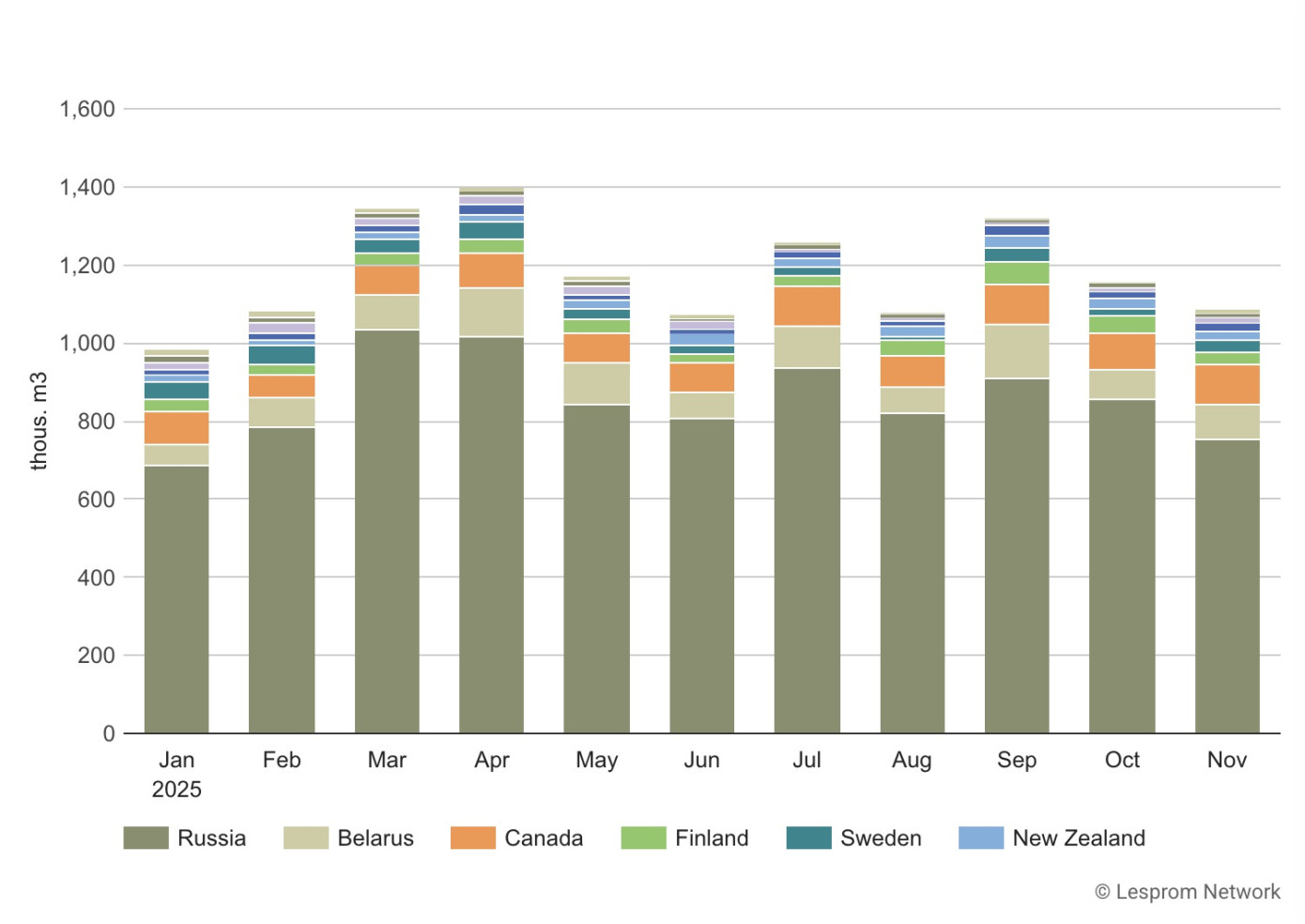
Canada and China confirmed support for two-way investment and trade in clean and conventional energy, agriculture, and other sectors. China remains Canada’s second-largest customer for agriculture, forest, and seafood products, with sales of approximately $13.4 billion in 2024.
The roadmap also renews the Joint Economic and Trade Commission, led by the Department of Foreign Affairs, Trade and Development of Canada and the Ministry of Commerce of China, as the main forum for advancing economic and trade cooperation and resolving trade differences.
Both governments agreed to promote sustainable trade and investment, including trade in green products. The memorandum on wood construction is one of several new agreements signed to strengthen technical and economic collaboration between Canada and China.
Canada and China will continue cooperation through the Asia-Pacific Economic Cooperation framework to advance mutual objectives in sustainable trade, innovation, and investment. Canada supports China’s hosting of the 2026 APEC meetings and appreciates China’s support for Canada’s offer to host the 2029 summit.
The Government of Canada is pursuing these initiatives as part of a wider effort to diversify export markets in response to higher U.S. tariffs on Canadian softwood lumber. In August, the U.S. Department of Commerce set final combined countervailing and antidumping duty rates on softwood lumber imports from Canada ranging from 26.47% to 47.65% for the sixth administrative review covering 2023. Canfor received the highest total rate of 47.65%, including a 12.12% countervailing duty and a 35.53% antidumping duty, while West Fraser had the lowest at 26.47%, with a 16.82% countervailing duty and a 9.65% antidumping duty. Rates for non-selected companies were set at 35.19%, including a 14.63% countervailing duty and a 20.56% antidumping duty.
In November, delegates from British Columbia’s largest forestry trade mission to Asia signed new agreements in Japan and South Korea to strengthen market access and investment. The government of British Columbia said that the mission enhanced cooperation on wood construction technologies, safety standards, and sustainable building practices. Two memorandums of understanding were signed: one between Canada Wood and the Japan 2x4 Home Builders Association to expand mid-rise and non-residential wood construction in Japan, and another among Canada Wood, Forestry Innovation Investment, and the Korea Land and Housing Research Institute to promote wood-based housing aligned with South Korea’s carbon-neutrality goals.
The mission involved over 60 delegates, including seven representatives from First Nations and First Nations-owned forestry businesses, and engaged more than 300 customers and partners across 20 meetings and site visits.
In January, British Columbia also led a trade mission to India, headed by Premier David Eby, focused on expanding exports of forestry products, renewable energy, and responsible mining projects. The province plans to open a new forestry trade office in London to increase softwood lumber exports to the United Kingdom and Europe, as part of a strategy to shift up to 10% of Canada’s lumber exports, around one billion board feet annually, away from the U.S. market.