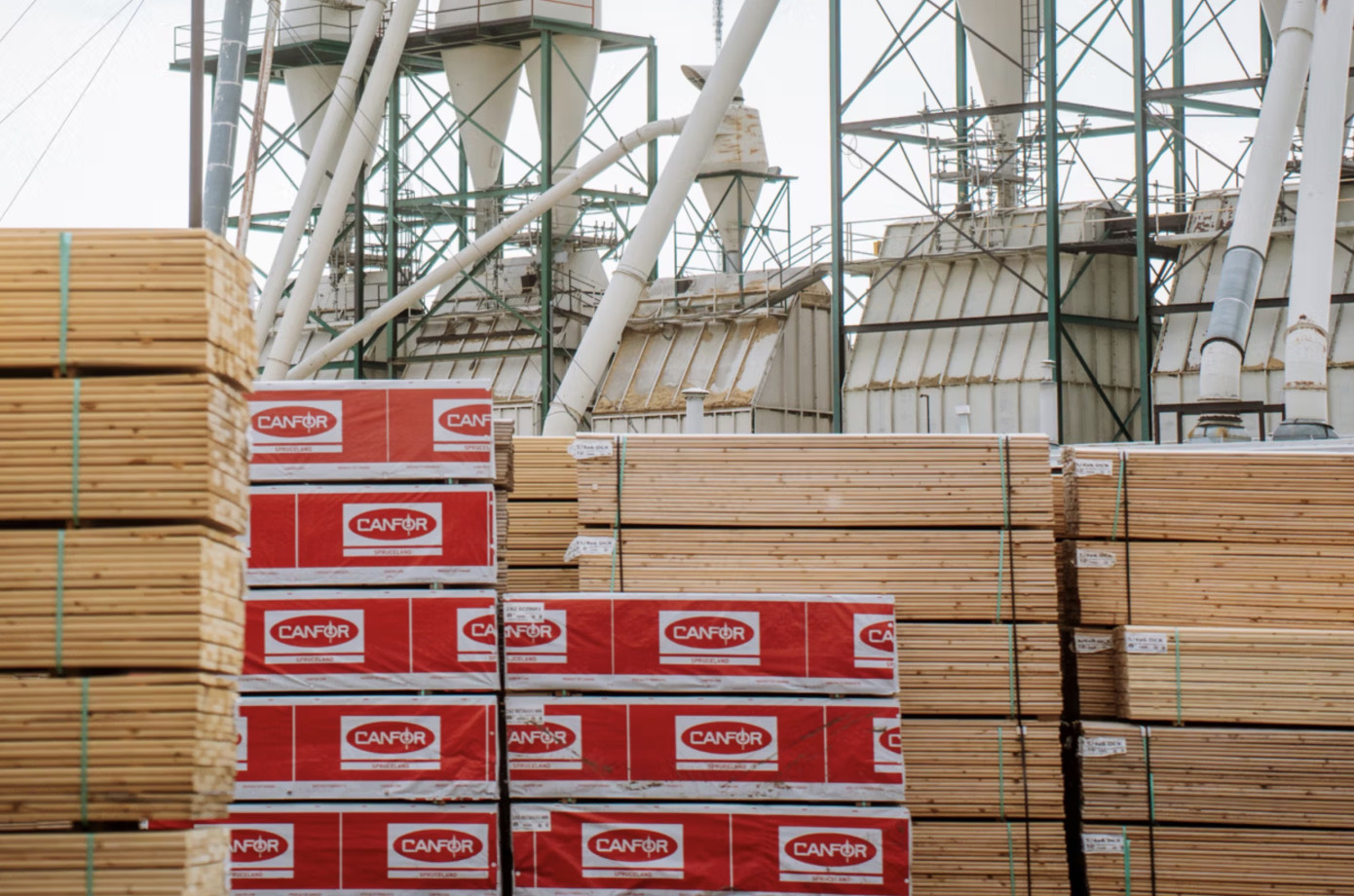
Canfor recorded an operating loss of $415.9 million in the fourth quarter of 2025 on sales of $1,282.3 million, and it posted a net loss of $390.5 million, or $3.35 per share. The quarter included asset write-downs and impairments of about $320.4 million (including a $52.5 million write-off of a previously recognized deferred tax asset) and adjusting and one-time items totaling $270.9 million.
Impairments included $213.9 million in the lumber segment and $106.5 million in pulp and paper (which includes the deferred tax asset write-off). After adjustments, the company reported an adjusted operating loss of $145.0 million, compared with a similarly adjusted operating loss of $111.3 million in the third quarter.
North American lumber markets remained under pressure through most of the quarter as elevated countervailing and anti-dumping duties and heightened uncertainty following the introduction of a 10% tariff under Section 232 in October weighed on demand. Benchmark lumber prices improved late in the quarter after industry-wide sawmill curtailments announced in mid-December, low inventory levels, and seasonal production curtailments tightened supply.
Lumber production rose 2% from the previous quarter, driven primarily by a full-quarter contribution from the recently acquired Hedin sawmills in Europe, partly offset by seasonal holiday downtime across operating regions. Production and shipments declined in North America due to year-end downtime, while Europe posted higher production and shipments following seasonal summer downtime in the prior quarter.
Offshore lumber demand and pricing in Asia stayed subdued, with weakness in China’s housing and real estate sectors weighing on pricing and Japan demand moderating with relatively flat pricing versus the prior quarter. In Europe, demand remained under pressure despite seasonal inventory replenishment, while constrained spruce log availability and persistently high log costs limited buying.
In pulp and paper, Canfor Pulp Products reported an operating loss of $85.6 million versus $16.0 million in the prior quarter, and an adjusted operating loss of $28.1 million versus $11.1 million. The quarter included reduced pulp production tied to scheduled maintenance downtime at the Northwood NBSK pulp mill.
Global softwood pulp markets were relatively flat as producer inventories remained elevated, ending December at 47 days of supply, the top end of the company’s stated balanced range of 39 to 47 days. U.S.-dollar NBSK list prices to China finished December at US$690 per tonne; the quarterly average was US$671 per tonne, down 3% from the prior quarter, and the average list price to North America fell 8% from the prior quarter.
Canfor planned no major maintenance outages at its pulp mills in the first quarter of 2026. It scheduled a second-quarter outage at the Intercontinental NBSK mill that it expected would reduce market pulp production by 20 thousand tonnes, with no further scheduled downtime expected for the rest of 2026. Management forecast further deterioration in pulp results in the first quarter of 2026 and said covenant non-compliance at March 31, 2026 was highly probable, with lender discussions paused while a proposed transaction remained pending and with plans to seek additional temporary covenant relief if the transaction did not close.