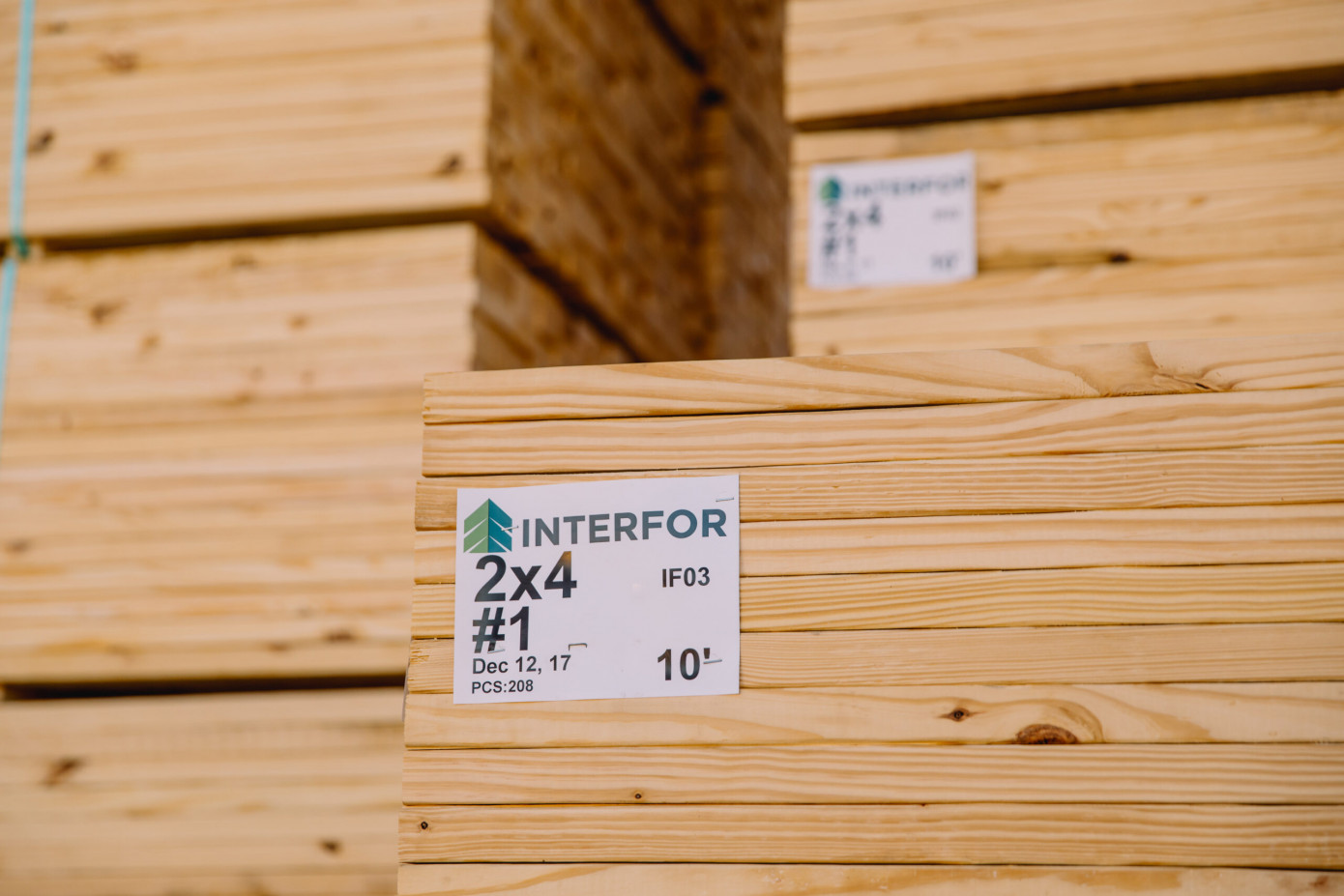
Interfor recorded a net loss of $63 million in the first quarter of 2026, compared with a $105 million net loss in the prior quarter, as benchmark lumber prices rebounded and the company’s average selling price rose to $666 per thousand board feet. The company posted adjusted EBITDA of $31 million on sales of $643 million in the quarter, Interfor Corporation reported.
Lumber production totaled 856 million board feet, up from 753 million board feet in the prior quarter, driven by higher operating rates at the U.S. Northwest and British Columbia operations. By region, production totaled 408 million board feet in the U.S. South, 111 million board feet in the U.S. Northwest, 177 million board feet in Eastern Canada, and 160 million board feet in British Columbia.
The prior quarter’s production was impacted by temporary curtailments in response to weak market conditions. In the first quarter, the company indefinitely curtailed operations at its Ear Falls, Ontario sawmill, and it curtailed operations at its Nairn and Gogama, Ontario sawmills in April 2026.
Lumber shipments totaled 806 million board feet, about 6% below production, and inventory volume increased by 52 million board feet. The shortfall was primarily attributed to logistics constraints across the U.S. toward the end of the quarter.
The company generated $23.8 million of operating cash flow before working-capital changes and invested $22.9 million in working capital, driven by shipment delays and seasonally higher log inventories in Canada. Available liquidity totaled $386 million at March 31, 2026, and net debt totaled $858 million.
Capital spending totaled $35 million, including $28 million of discretionary spending mainly tied to the rebuild of the Thomaston, Georgia sawmill. The rebuild was completed during the quarter, and the mill was ramping up toward a production capacity of 240 million board feet per year.
Interfor expected near-term North American lumber markets to remain volatile as the economy adjusted to changing monetary policies, tariffs, oil price volatility and geopolitical uncertainty. From the end of December 2025 through the end of April 2026, it cited benchmark price gains of US$118 per thousand board feet for the SYP Composite, US$103 for KD H-F Stud 2x4 9’, US$82 for the Western SPF Composite, and US$66 for the Eastern SPF Composite.
The U.S. Department of Commerce issued preliminary combined anti-dumping and countervailing duty rates for a combined all-others rate of 25% for its seventh administrative review, and the company expected a non-cash incremental expense of about US$73 million in the second half of 2026 based on that preliminary rate. It also expected a US$5.2 million refund tied to liquidation of duties from the first administrative review, and US$3.8 million had been received as of Thursday.