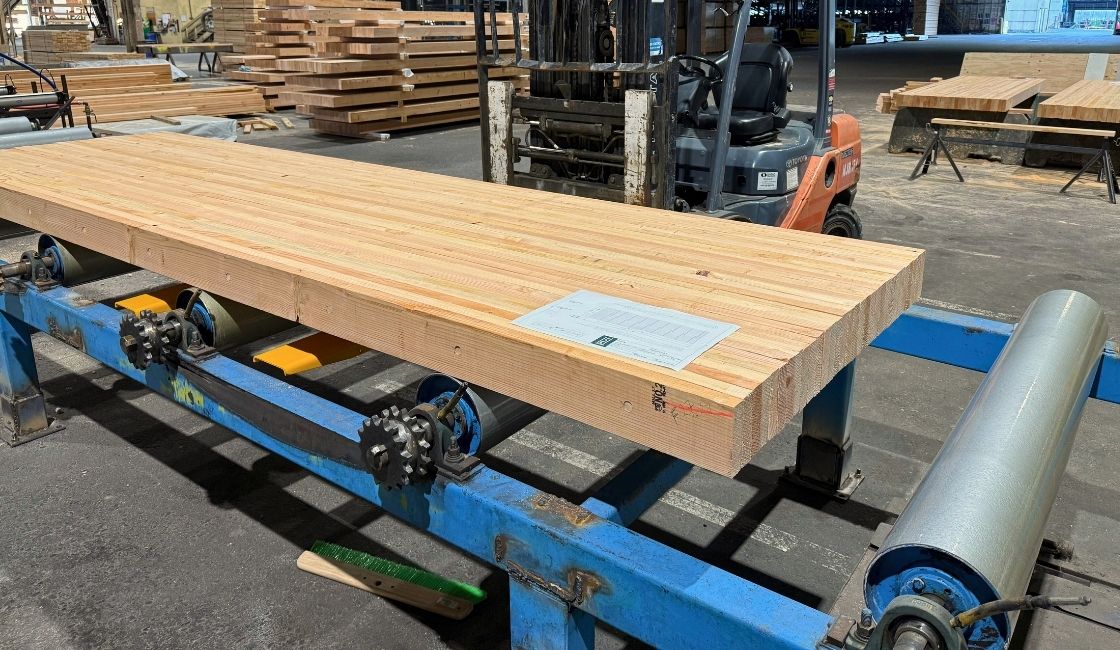
Mad River Mass Timber (MRMT) has opened California’s first commercial dowel-laminated timber (DLT) manufacturing facility in Humboldt County. The project is based on research from Assistant Professor Paul Mayencourt and his team at the University of California, Berkeley Wood Lab, according to UC Berkeley.
The facility produces mass timber panels using DLT technology, which joins layers of wood with wooden dowels rather than chemical adhesives. This makes the product fully recyclable and suitable for low-carbon construction. MRMT transforms waste wood and underused species such as red fir, hemlock, and Ponderosa pine into structural panels for floors, roofs, walls, and beams.
DLT can also utilize fire-damaged or small-diameter trees, turning previously low-value or unusable material into construction-grade timber. MRMT sources its wood from California forests, including national forests and tribal lands involved in forest health and wildfire mitigation projects. This process reduces biomass that can fuel wildfires while providing a new revenue stream for forest management.
The company designed and built its own DLT machine using standard components to enable efficient production at scale. It is the first vertically integrated mass timber producer in California, processing local timber into finished products at a single site.
Assistant Professor Mayencourt and the UC Berkeley Wood Lab guided MRMT in developing the process and design codes for DLT products. Their collaboration was supported by the Joint Institute for Wood Products Innovation.
Mass timber, including DLT, stores carbon within the wood structure and reduces reliance on high-emission materials such as steel and concrete. Research published in Building and Environment found that mass timber buildings lower global warming potential by 39–51% compared to equivalent reinforced concrete buildings and 28–34% compared to those made with structural steel. Another study found that the average embodied energy of mass timber buildings is 23% higher than reinforced concrete alternatives.
Until now, California builders imported mass timber from Washington or Canada, limiting environmental benefits due to long-distance transport. Locally produced DLT eliminates that transport burden and strengthens the state’s capacity for sustainable building.
MRMT President George Schmidbauer, a fifth-generation sawmill operator, said the company aims to connect forest restoration, wildfire mitigation, and low-carbon construction through affordable local production. He and Mayencourt are also developing prefabricated DLT kits for affordable multifamily housing, linking environmental performance with lower construction costs.
The plant’s operation is expected to stimulate local economic activity by creating jobs in Humboldt County and supporting forest-based communities. The company’s early projects are underway, and it is seeking additional partners focused on sustainable development.
Mayencourt said the collaboration demonstrates how design and engineering research can drive practical solutions for forest health, housing, and climate goals. The future development of California’s mass timber sector will depend on continued partnerships between industry and academia to expand local manufacturing capacity and accelerate decarbonization in the construction industry.